

In the race to 400G, 800G, and beyond, the physical form factor of your transceiver matters just as much as the speed. You are likely facing a alphabet soup of acronyms: OSFP vs QSFP-DD vs SFP-DD.
Which one fits your next-generation data center?
-
OSFP: The powerhouse for thermal management.
-
QSFP-DD: The backward-compatibility king.
-
SFP-DD: The high-density server solution.
In this guide, we break down the engineering differences, compare thermal capabilities, and provide a clear decision matrix to help you choose the right standard for your architecture.
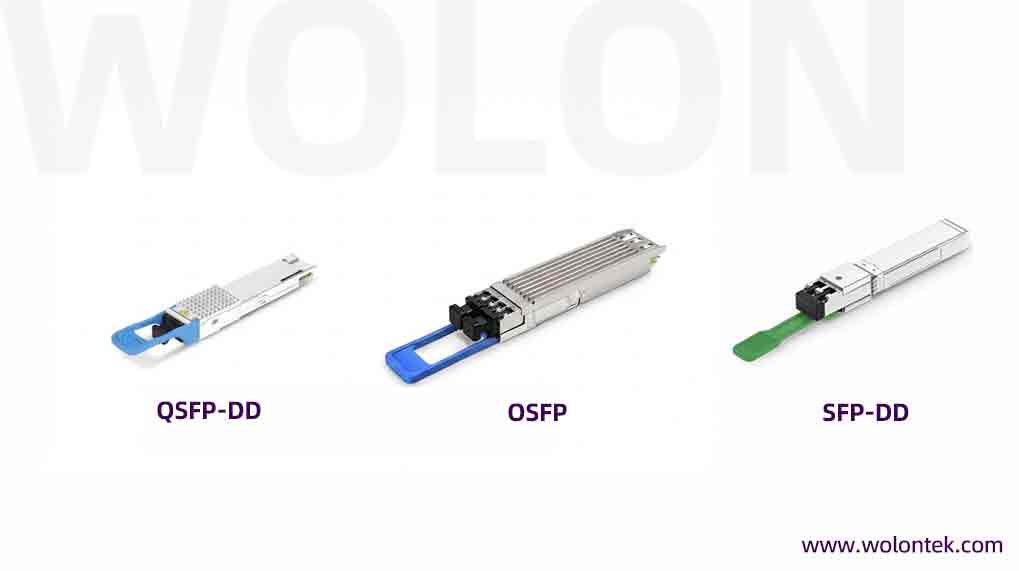
What is OSFP? (Octal Small Form Factor Pluggable)
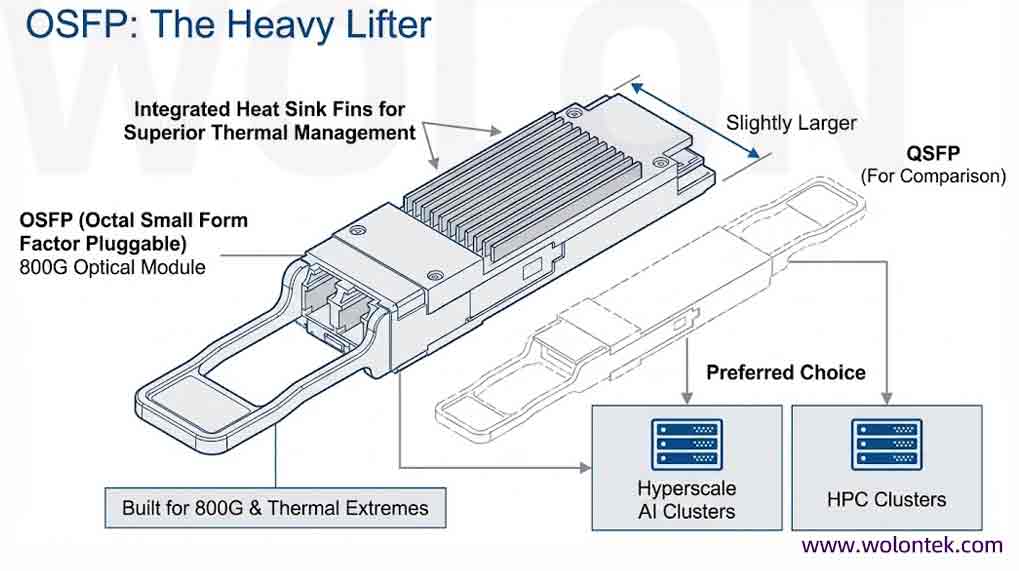
The Heavy Lifter: Built for 800G & Thermal Extremes
OSFP (Octal Small Form Factor Pluggable) is a high-performance pluggable form factor designed with one goal: Maximum Thermal Capacity. It is slightly larger than the QSFP form factor, but that extra space is used for superior cooling, making it the preferred choice for hyperscale AI and HPC clusters.
Key Features & Specs
Lanes: 8 high-speed electrical lanes (Octal).
Data Rates: Supports 400G, 800G, and is ready for 1.6T.
Power & Cooling: Supports up to 15W-20W per port.
Unique Design: Unlike QSFP-DD, the OSFP module has an integrated heat sink directly on the module body. This allows for much more efficient cooling in high-power 800G/1.6T applications.
Dimensions: 22.58 x 13 x 100.4mm (Slightly wider and deeper than QSFP-DD).
When to Use OSFP?
Based on our deployment experience, OSFP is the clear winner for:
-
AI/ML Clusters: GPU interconnects running at full load generate immense heat. OSFP handles this best.
-
Next-Gen Cloud Core: For 800G backbones where backward compatibility is less important than raw performance.
-
HPC (Supercomputing): Where every watt of cooling efficiency counts.
What is QSFP-DD? (Quad Small Form Factor Pluggable Double Density)
The Upgrade King: Backward Compatible & Dense
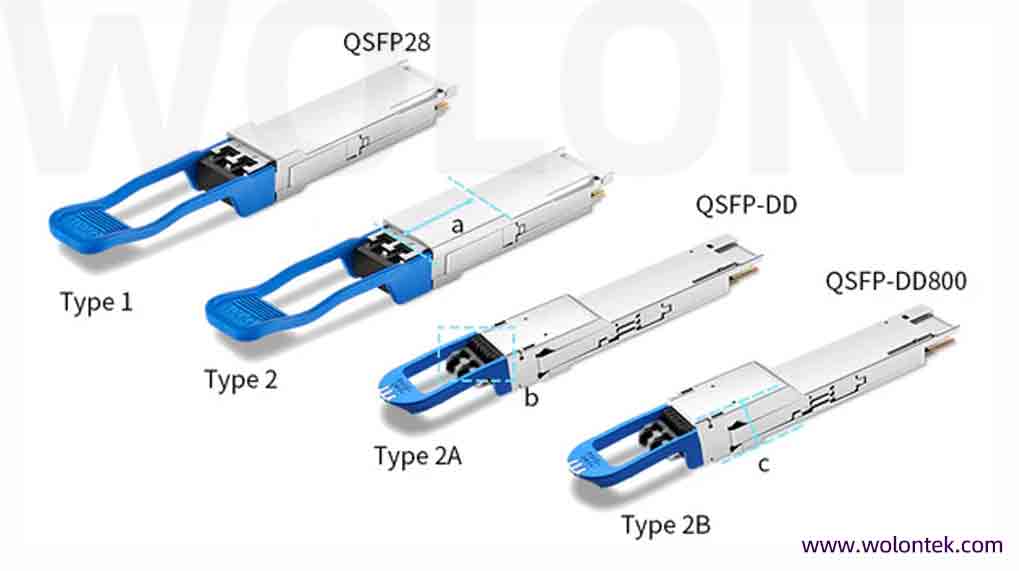
QSFP-DD stands for Quad Small Form Factor Pluggable Double Density. It is currently the industry favorite for a simple reason: Evolution, not Revolution. It allows data centers to upgrade to 400G/800G without replacing their entire legacy infrastructure.
Key Features & Specs
Lanes: 8 electrical lanes (Double Density interface).
Data Rates: 200G, 400G, and 800G via PAM4 modulation.
Backward Compatibility: This is its superpower. A QSFP-DD port can accept legacy QSFP+, QSFP28, and QSFP56 modules.
Power: Typically handles up to 12W-15W.
Density: Fits 36 ports in a 1U rack, delivering up to 14.4Tbps total bandwidth.
When to Use QSFP-DD?
I recommend QSFP-DD for 90% of standard enterprise and cloud deployments:
-
Mainstream Data Centers: If you have piles of old 100G QSFP28 modules you want to keep using.
-
Spine-Leaf Architecture: Perfect for high-density switching without requiring new cable types.
-
Cost-Sensitive Upgrades: Avoids the “Forklift Upgrade” problem by allowing mixed port speeds.
See it in Action: Backward Compatibility Explained It can be hard to visualize how a “Double Density” port physically accepts a standard module without looking inside the cage. This video breaks down the mechanical and electrical compatibility between OSFP vs QSFP-DD transceivers in under 3 minutes.
What is SFP-DD? (Small Form Factor Pluggable Double Density)
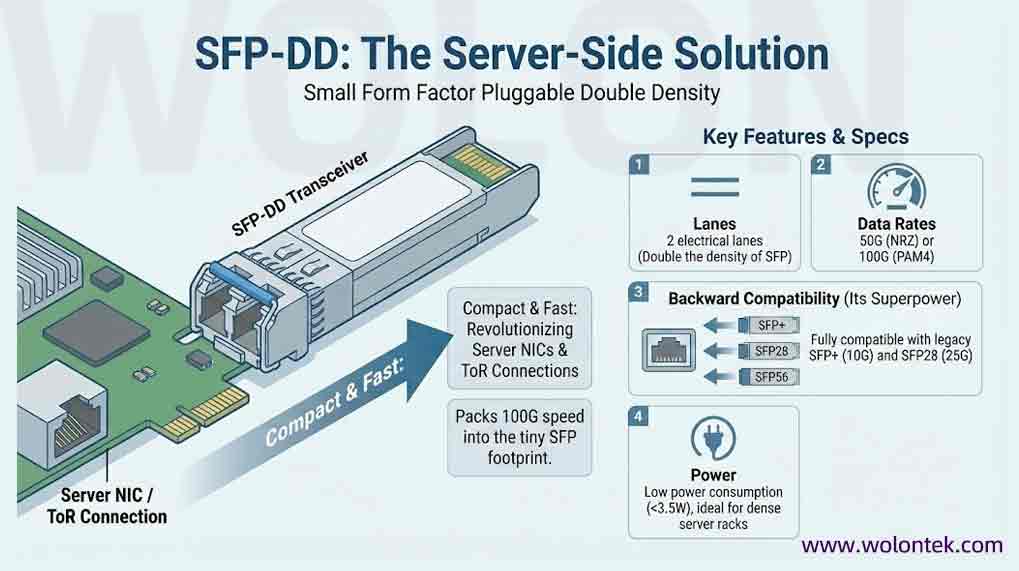
The Server-Side Solution: Compact & Fast
While OSFP and QSFP-DD fight for the switch slots, SFP-DD is quietly revolutionizing the server Network Interface Card (NIC) and Top-of-Rack (ToR) connections. It packs 100G speed into the tiny SFP footprint.
Key Features & Specs
Lanes: 2 electrical lanes (Double the density of SFP).
Data Rates: 50G (NRZ) or 100G (PAM4).
Backward Compatibility: Fully compatible with legacy SFP+ (10G) and SFP28 (25G).
Power: Low power consumption (<3.5W), ideal for dense server racks.
When to Use SFP-DD?
-
Server Uplinks: Connecting high-performance servers to ToR switches at 50G or 100G.
-
Enterprise Core: For networks that need more than 25G but don’t have the space for QSFP modules.
-
Space-Constrained Racks: Doubling bandwidth without changing the physical rack layout.
The Showdown: OSFP vs. QSFP-DD vs. SFP-DD
Which form factor wins on specs? Here is the side-by-side comparison.
Final Decision Matrix: Which Should You Choose?
Don’t overcomplicate it. Use this simple logic guide for your next purchase:
✅ Choose OSFP If…
You are building an AI Training Cluster or Supercomputer.
You need 800G speeds today and want a path to 1.6T.
Cooling is your #1 concern (the integrated heat sink is a game changer).
✅ Choose QSFP-DD If…
You are a Standard Cloud / Enterprise Data Center.
You want to reuse your existing stock of 100G QSFP28 optics.
You need maximum port density (36 ports/1U) without changing physical infrastructure.
✅ Choose SFP-DD If…
You are upgrading Server NICs from 25G to 50G/100G.
You are space-constrained at the Edge or Top-of-Rack.
You need to maintain compatibility with 10G SFP+ legacy gear.
Conclusion: The “Form Factor War” is Over (They All Won)
If you take one thing away from this guide, let it be this: There is no single “Best” form factor. Unlike the old “VHS vs. Betamax” format wars, OSFP, QSFP-DD, and SFP-DD are not trying to kill each other. They are evolving to fill specific niches in the 400G/800G ecosystem:
-
OSFP will dominate the AI & Supercomputing world, where thermal physics is the only rule that matters.
-
QSFP-DD will remain the workhorse of Enterprise & Cloud Data Centers, protecting billions of dollars in legacy infrastructure investment.
-
SFP-DD will quietly power the next generation of High-Performance Servers, doubling density without changing the rack layout.
Your Strategy? Don’t be dogmatic. You will likely end up with a hybrid network using OSFP for your AI Cluster spine and QSFP-DD for your general compute fabric.
The Smart Sourcing Move: Regardless of which form factor you deploy, the physics of the optical lasers inside (EML/VCSEL) remain the same. The only difference is the sticker on the outside.
Build Your 800G AI Cluster. Keep Your Budget.
Whether you choose OSFP for NVIDIA GPU clusters or QSFP-DD for cloud switching, Wolontek delivers the same Tier-1 lasers and DSPs as the big brands—at Factory Direct prices.
Compatible with NVIDIA, Arista, Cisco & Juniper.
FAQ: 400G & 800G Form Factors Explained
Q1: Can I plug an OSFP module into a QSFP-DD port?
A: No. OSFP is physically wider and deeper than QSFP-DD. It will not fit into a QSFP-DD cage.
The Exception: You can plug a QSFP-DD module into an OSFP port using a special mechanical adapter. This allows newer OSFP switches to support legacy QSFP hardware, but not the other way around.
Q2: Why choose OSFP if QSFP-DD is backward compatible?
A: Because of Heat (Thermals). QSFP-DD relies on the switch chassis to dissipate heat (using a “riding heat sink”). As speeds hit 800G and 1.6T, the heat generated by the laser can exceed what a standard switch cage can handle. OSFP modules have an integrated heat sink built directly onto the module, allowing them to handle higher power loads (up to 20W+) required by AI and Hyperscale networks.
Q3: Is SFP-DD compatible with my old 10G SFP+ Server?
A: Yes. SFP-DD ports are fully backward compatible.
If you buy a new server with SFP-DD ports, you can plug in your old 10G SFP+ or 25G SFP28 transceivers, and they will work perfectly.
Note: You cannot plug a new SFP-DD module into an old SFP+ port (it simply won’t fit electrically).
Q4: Which form factor is winning the “Format War”?
A: Both are winning, but in different arenas.
QSFP-DD is winning in the Enterprise & Cloud Data Center market due to its backward compatibility with 100G QSFP28.
OSFP is winning in the AI & Supercomputing (HPC) market where maximum thermal performance is critical.
Q5: Does Wolontek offer 800G modules in both OSFP and QSFP-DD?
A: Yes. We recognize that the market is split. Wolon manufactures and stocks 800G transceivers in both form factors. Whether your switch architecture is based on NVIDIA (often OSFP) or Cisco/Arista (often QSFP-DD), we have the compatible optics.